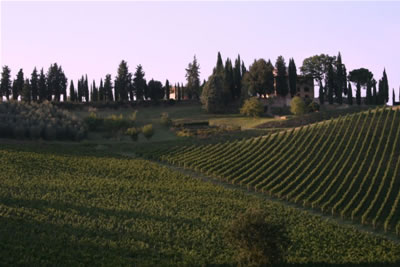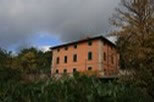
Montenisa, also known as Villa Manetto, is set in the Tuscan countryside, very close to the small village of Montefiridolfi (Florence), reachable on foot with a short 1 km walk: it belongs to the municipality of San Casciano, Tuscany, in the heart of the Chianti Classico wine-producing area.
The villa enjoys an ideal position, right next to the hamlet of Montefiridolfi: Florence is about 30 minutes away, and Siena about 40. It is surrounded by green grounds and has a terrace with a view over the area of S.Donato and Tavarnelle Val di Pesa.
It was built by Manetto in 1934, who personally oversaw its construction using the best building techniques available at the time - though he unfortunately never got to live in it, which is why it is still known locally as "Villa Manetto". The house was later sold by his heirs and had various uses over the years: among them, it served as a holiday colony, and as the small staff club of the nearby Antinori estate, still remembered today by the older residents of Montefiridolfi - two remaining bocce courts bear witness to that period.
The villa was later divided into several apartments, used by staff of the Antinori estate until it was put up for sale again - together with a few hectares of vineyard in the Montefiridolfi area - and was bought by Gualtiero Armando Nunzi, who was, among other things, president of the Chianti Classico Consortium and founder of the Grevepesa wine cellars.
Gualtiero Armando Nunzi was not interested in the building itself, only in the vineyards: he therefore had it restored and put back up for sale, and this is how Montenisa came into the hands of its current owners in 1976.
The villa is also mentioned in a publication about the events of the wartime period in the Montefiridolfi area - it was used as a German command post: the publication, titled "Memorie del passaggio del fronte a Fabbrica e Montefiridolfi" ("Memories of the front passing through Fabbrica and Montefiridolfi", in Italian) by Franco Bartalesi, also includes period images, photos and maps of the area, and can be downloaded through the links on this site in various electronic formats.
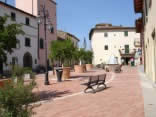
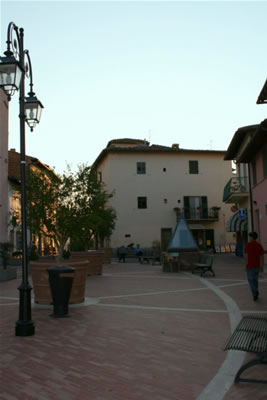
Montefiridolfi - affectionately called "Monte" by the locals, the "montigiani" - is a charming little village nearby, with a newsagent/stationer's and general store - L'Arcobaleno -, 2 grocery shops, and a good restaurant, "a casa mia", also featured in the guide "Osterie d'Italia" by Slow Food.
There is the church, and next to it the castle - probably the oldest part of Montefiridolfi.
Nearby are the remains of an Etruscan tomb, the so-called "Tomba Etrusca Arciere" (Archer's Etruscan Tomb), discovered in 1978.
Repetti mentions Montefiridolfi in his 1833 "Dizionario Storico Geografico della Toscana" as follows (original Italian text):
"MONTEFIRIDOLFI in Val di Pesa. – Villa signorile fondata sopra i resti del castello omonimo con chiesa parrocchiale (S. Cristina a Montefiridolfi) cui fu annessa altra chiesa parrocchiale, nel piviere di S. Stefano a Campoli, Comunità Giurisdizione e quasi 4 miglia toscane a scirocco di San Casciano, Diocesi e Compartimento di Firenze. Si veggono ancora i ruderi del Castello di Montefiridolfi sopra una deliziosa collina posta a cavaliere della strada r. romana di rimpetto al ponte della Pesa. Diede il nome a questo resedio baronale un Ridolfo de'Buondelmonti, di cui era consorte quel Sichelmo di Giovanni che, nel maggio dell'anno 1015, rinunziò a favore della badia Passignanese nelle mani dell’abate Walperto il padronato della chiesa di S. Maria a Macerata e delle case e terre da esso possedute nel castello di Paterno, in Tizzana, in Cerreto, e a S. Cristina, nel piviere di S. Stefano a Campoli. – Vedere MACERATA in Val di Pesa. La villa di Montefiridolfi dopo tanti secoli non ha cambiato padroni, poiché essa tuttora dipende dall’ultima femmina di casa Buondelmonti vedova del marchese Ubaldo Feroni, che ha ceduto al principe il giuspadronato della suddetta chiesa parrocchiale, conservando gli effetti. La parrocchia di S. Cristina a Montefiridolfi nel 1833 contava 269 abitanti."
According to the 2001 census, Montefiridolfi had 368 inhabitants.
Nearby places
There are sections dedicated to the places around Montefiridolfi: Mercatale Val di Pesa, the closest town, and San Casciano Val di Pesa, the seat of the municipality.
From Montefiridolfi you can quickly reach a number of smaller places nearby, which individually may not offer unforgettable sights - it's impossible to compete with nearby Siena and Florence - but which, taken together, help you get into the spirit of the area and feel the magic of the Chianti: a land with a very particular character, rich in historical memories, even though the first thing that comes to mind is often its wine...
So there are, of course, hills, vineyards, parish churches and abbeys, farmhouses and castles, each with its own small piece of history and character. That's why the idea is to gather images and information about Montenisa, the Montefiridolfi area and the Sienese Chianti: and as I kept collecting and organising this material, I felt I was understanding and appreciating this area better - certainly a difficult thing to do if you don't live here...
Tuscany and the Chianti have long fascinated famous travellers - no one mentions Montefiridolfi explicitly, but as early as 1786 Goethe wrote (original Italian): "non è possibile vedere una campagna meglio tenuta; nemmeno una zolla di terra che non sia pulita e come passata attraverso lo staccio..." while Piero Calamandrei, in his "inventario della casa di campagna", wrote: "Questa è la terra dove pare che anche le cose abbiano acquistato per lunga civiltà il dono della semplicità e della misura."
What is absolutely certain is that the surrounding area keeps offering surprises and discoveries: even though I spend most of the year at Montenisa, and have known the Montefiridolfi area for more than 30 years, I invariably end up discovering things I didn't know about.
 Website by Virgix [ virgilio.org ] | site map | Contacts | Privacy info
 Montenisa.com is published under a Creative Commons Licence.